


Quanwei Machinery Group (Jiangsu) Co., Ltd., kısaca Quanwei Machinery olarak anılır. Şirketin ana markaları Quanwei ve Yongying'dir. Quanwei Makine Fabrikası 1986 yılında kurulmuştur ve Tayvan'ın Kaohsiung Şehri, Lingya Bölgesi'nde bulunmaktadır. Araştırma ve geliştirme, tasarım, üretim ve satış ile kapsamlı bir vidalı kompresör üreticisidir.


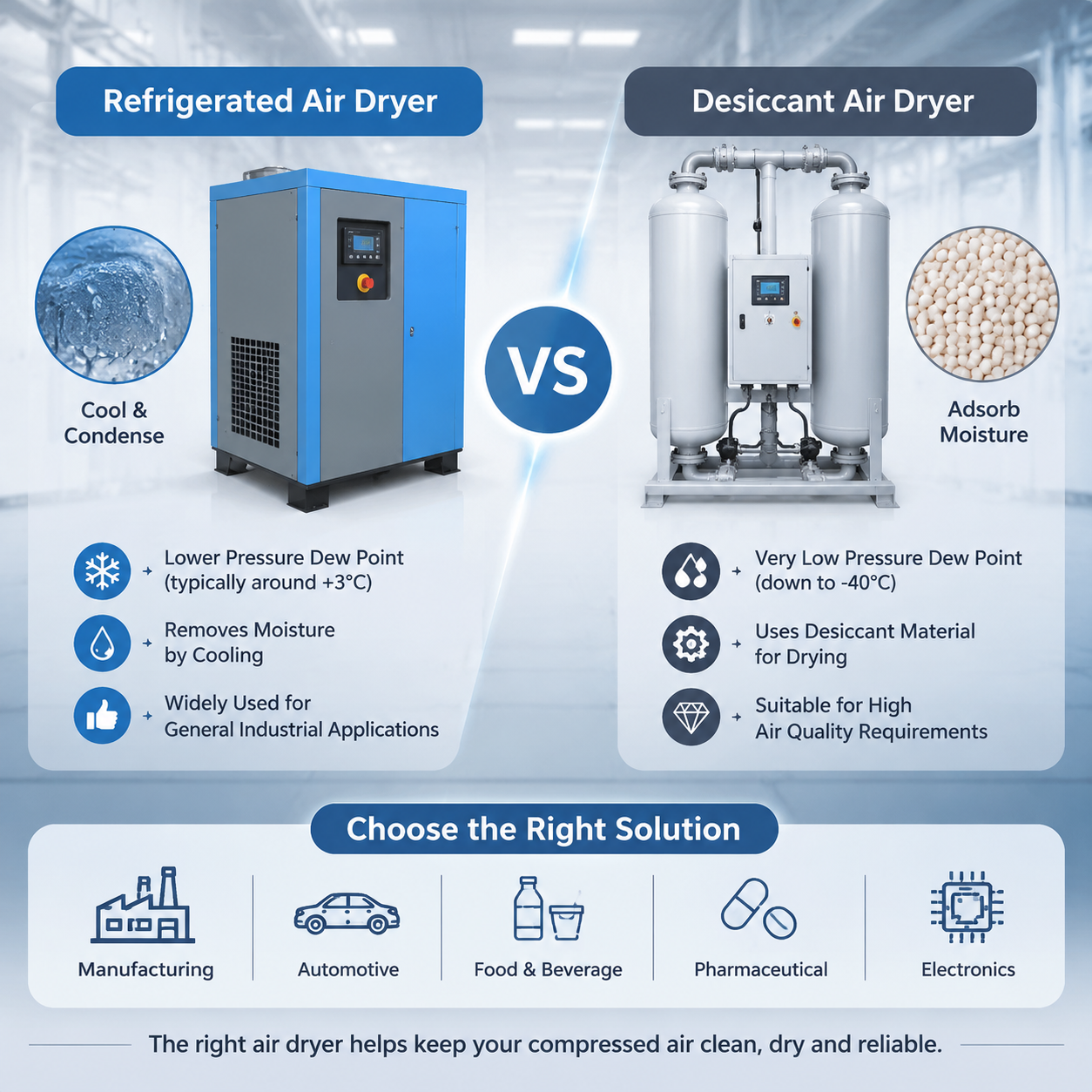
Choosing the right air dryer is an important part of building a reliable compressed air system. But how do you determine the correct air dryer capacity? Should it match the air compressor or depend on actual air consumption? One customer recently asked: "I'm still new to compressor. For dryer capacity, is it depend on the compressor/booster or depend on air usage?" This is a common question, especially for first-time compressed air system buyers. The answer is that air dryer sizing should start with the maximum airflow passing through the dryer, while actual operating conditions must also be considered. Let's look at how to choose the right air dryer for your screw air compressor. 1. How to Choose the Right Air Dryer Capacity? For a standard compressed air system, the compressor's Free Air Delivery (FAD) is usually the starting point for air dryer sizing. For example, if a screw air compressor delivers 10 m³/min, the dryer should be selected to handle the required airflow under the actual operating conditions. However, compressor power (kW) and airflow (m³/min) are different parameters. Two compressors with the same motor power may have different air delivery capacities. Therefore, when selecting an air dryer, always check the compressor's rated FAD rather than choosing a dryer based on motor power alone. 2. Does Actual Air Consumption Affect Air Dryer Sizing? Yes. Actual air consumption is important when designing a compressed air system, but average consumption should not be confused with maximum airflow. For example: Compressor rated airflow: 10 m³/min Normal factory air consumption: 6–8 m³/min If the compressor can deliver up to 10 m³/min, the dryer may need to handle the full compressor output, even if normal consumption is lower. For systems with multiple compressors, varying demand or special flow-control arrangements, the maximum airflow through the dryer should be evaluated based on the system design. The key is to size the dryer according to the maximum required airflow through it, not simply the average air consumption. 3. What Factors Affect Air Dryer Capacity? Besides airflow, several operating conditions affect the actual capacity of a compressed air dryer. Working Pressure The dryer must be suitable for the system's operating pressure. A standard 8-bar dryer cannot automatically be used in a 30-bar or 40-bar application. Inlet Air Temperature Higher compressed air inlet temperatures increase the drying load and may reduce the dryer's effective capacity. Ambient Temperature For refrigerated air dryers, high ambient temperatures can affect cooling performance and drying capacity. Pressure Dew Point (PDP) Pressure dew point indicates the required dryness of compressed air. General industrial applications commonly use refrigerated air dryers, while applications requiring much lower dew points may need desiccant air dryers. Manufacturers provide correction factors to account for differences between actual operating conditions and rated conditions. Always check these factors before confirming the dryer model. 4. Refrigerated Air Dryer vs. Desiccant Air Dryer Which type of air dryer should you choose? Refrigerated Air Dryer A refrigerated air dryer cools compressed air to condense and remove moisture. It is commonly used in general manufacturing, workshops and pneumatic applications. Desiccant Air Dryer A desiccant air dryer uses adsorbent materials to remove moisture and achieve a lower pressure dew point. It is suitable for applications requiring very dry compressed air. The right choice depends on your required air quality and application, not simply the compressor size. 5. Common Mistakes When Selecting an Air Dryer Here are some common mistakes to avoid: Selecting a dryer based only on compressor motor power. Choosing capacity according to average air consumption without checking peak airflow. Ignoring working pressure and inlet air temperature. Overlooking ambient temperature and manufacturer correction factors. Choosing a dryer without confirming the required pressure dew point. If a booster is included, also consider its position in the system. A dryer installed before the booster is selected according to the conditions on the compressor side, while a dryer installed after it must match the booster discharge conditions. 6. What Information Is Needed to Select an Air Dryer? Before requesting an air dryer quotation, prepare the following information: Parameter Example Airflow (FAD) 10 m³/min Working pressure 8 bar Inlet air temperature 35°C Ambient temperature 30°C Required pressure dew point +3°C Power supply 380V / 50Hz / 3Ph Application General industrial use Providing these details helps suppliers evaluate the required dryer capacity and recommend a suitable model. Skid-mounted screw air compressor for laser cutting machine. Assembled with refrigerated dryer and modular dryer(dessicant dryer). FAQ Q1: Should an air dryer have the same capacity as the air compressor? Not necessarily. The dryer's rated capacity must be checked against the maximum required airflow and actual operating conditions. Correction factors may affect the final model selection. Q2: Can I select an air dryer based on actual air consumption? Actual consumption is important, but peak airflow through the dryer must also be considered. Average consumption alone may result in an undersized dryer. Q3: Does a higher working pressure require a different air dryer? Yes. The dryer must be designed for the intended operating pressure. High-pressure applications may require specially designed dryers. Q4: Which is better, a refrigerated or desiccant air dryer? Neither is universally better. A refrigerated dryer is suitable for many general industrial applications, while a desiccant dryer is used when a lower pressure dew point is required. Conclusion Selecting the right air dryer is not just about matching its capacity to the compressor's motor power or the factory's average air consumption. Start with the compressor's airflow, determine the maximum flow through the dryer, and consider working pressure, temperature and required pressure dew point. A properly selected air dryer helps maintain compressed air quality, protect downstream equipment and support reliable production. Looking for a suitable air dryer for your screw air compressor? Contact Quanwei Machinery for professional equipment selection and compressed air solutions.
DAHA FAZLA BİLGİ EDİN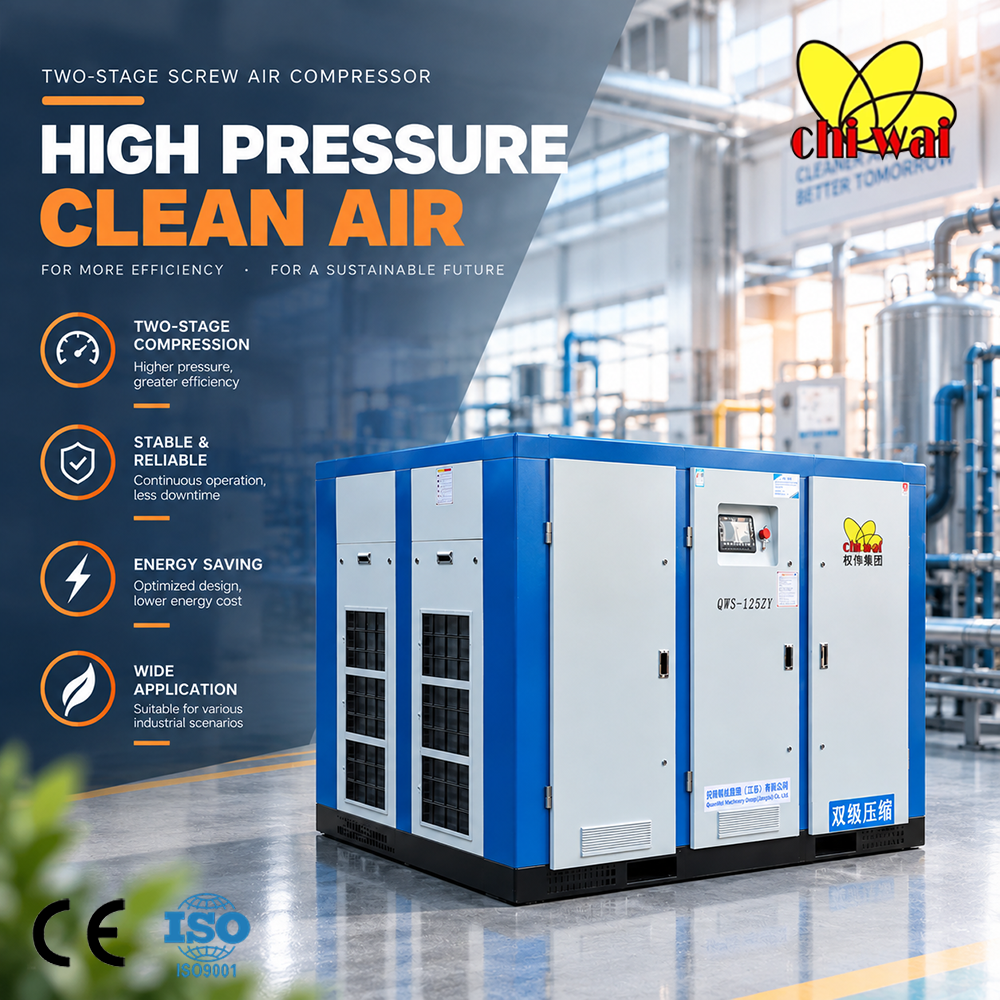
For customers who already understand the basics of screw air compressors, a common question is: Why can a two-stage screw compressor achieve higher efficiency than a single-stage compressor? The answer is not simply that it has “two air ends.” The main advantage comes from how the compression ratio is distributed between the two stages and how the air is cooled between them. 1. The Key Difference: Compression Ratio A screw compressor needs to increase atmospheric pressure to the required discharge pressure. The larger the pressure increase, the greater the compression work. In a single-stage compressor, the entire pressure increase takes place in one compression stage. A two-stage compressor divides the overall compression process between two stages: Inlet → 1st Stage → Interstage Cooling → 2nd Stage → Final Discharge This reduces the compression ratio handled by each individual stage. For example, industry technical material gives a comparison at 100 psi: a single-stage compressor has an overall absolute compression ratio of about 7.9:1, while a two-stage design can divide the compression into approximately 2.9:1 in the first stage and 2.7:1 in the second stage. The exact ratios depend on the compressor design and operating conditions. 2. Why Does Dividing the Compression Help? Compressing air generates heat. When the entire compression process is completed in one stage, the air experiences a large pressure increase and a corresponding temperature rise. In a two-stage design, the air is partially compressed in the first stage and then cooled before entering the second stage. This interstage cooling reduces the temperature of the air before the second compression stage. The result is a more favorable compression process and improved thermal management. Multi-stage compression with intercooling is also widely used when higher pressure ratios need to be achieved efficiently. 3. Interstage Cooling Is More Than Just Temperature Control It is easy to think of the intercooler as simply a device for lowering air temperature. Its role is more important than that. After the first stage, the compressed air is cooled before entering the second stage. Lowering the air temperature reduces the work required for the subsequent compression compared with compressing the hotter air directly. This is one of the fundamental reasons why two-stage compression can improve energy efficiency. The design also helps manage the thermal load of the compressor, which is particularly valuable when the machine operates continuously. Vertical two stage similar 4. Lower Pressure Difference Can Also Reduce Internal Leakage Another factor is internal leakage. In a screw compressor, some compressed air can leak internally from the higher-pressure side back toward the lower-pressure side. The larger the pressure difference across the compression element, the greater the potential leakage loss. By dividing the overall compression process between two stages, the pressure difference handled by each stage can be reduced. Industry technical material identifies this reduction in differential pressure as another reason for the power advantage of two-stage compression. 5. Look at Specific Power, Not Just Motor Power This is especially important when comparing compressors. A 75 kW compressor is not necessarily more efficient than another 75 kW compressor simply because both have the same motor rating. A more useful performance indicator is specific power. In simple terms: Specific Power = Input Power ÷ Airflow For example, when comparing two compressors operating at the same pressure, a machine producing more airflow for the same input power has a lower specific power and is generally more energy-efficient. Performance should therefore be compared under equivalent conditions, including: Working pressure Airflow Input power Operating conditions This is why compressor selection should go beyond simply comparing motor kW. 6. Does Two-Stage Always Mean Lower Energy Consumption? Not automatically. The efficiency advantage of two-stage compression depends on the compressor design and operating conditions. For example, Hitachi/Sullair technical material states that its two-stage rotary screw compressors can offer a 12–15% power advantage compared with equally sized single-stage compressors under the specified comparison conditions. This should be understood as a product- and test-condition-specific comparison, not a universal saving rate for every two-stage compressor. When evaluating two compressors, it is therefore better to compare their actual performance data at the same pressure and airflow requirements. 7. When Does Two-Stage Compression Make More Sense? Two-stage compression can be particularly attractive when: The compressor operates for long hours. Air demand is relatively high. Energy consumption is an important part of operating cost. The required pressure creates a relatively high compression ratio. The potential energy savings can justify the additional investment. For some applications with lower pressure requirements or shorter operating hours, a well-designed single-stage compressor may still be the more economical choice. The correct question is therefore not: “Is two-stage better than single-stage?” but: “Which compression technology provides the best performance for this operating profile?” Conclusion The energy advantage of a two-stage screw compressor comes from several factors working together: Divided compression ratio → Interstage cooling → Lower pressure difference per stage → Reduced compression losses This can improve compression efficiency and thermal management compared with a single-stage design under suitable operating conditions. For customers comparing compressors, specific power, airflow and working pressure are more meaningful than motor power alone. Understanding these parameters makes it easier to evaluate whether a two-stage screw compressor is a worthwhile choice for a particular application. Looking for a two-stage screw compressor for your application? Contact Quanwei Machinery to discuss your required airflow, working pressure and operating conditions.
DAHA FAZLA BİLGİ EDİNAt Quanwei Machinery (Jiangsu) Co., Ltd., we believe that a company’s strength lies not only in its high-quality products but also in its respect for traditions and care for its team. As one of China’s most important traditional festivals, Qingming Festival (Tomb-Sweeping Day) is approaching, and we are pleased to share the origins and customs of this meaningful festival, along with our company’s holiday arrangement, to convey our gratitude to every employee and partner. Qingming Festival, usually falling on April 4th or 5th each year, has a history of over 2,500 years. Its origin can be traced back to the Spring and Autumn Period, initially as a festival to honor Jie Zitui, a noble man known for his loyalty and selflessness. Over time, it has evolved into a comprehensive festival that combines reverence for ancestors, commemoration of the deceased, and celebration of spring’s arrival. It is a time when Chinese people express their nostalgia for loved ones and embrace the vitality of the new season, reflecting the traditional values of filial piety, gratitude, and harmony with nature. There are many time-honored customs associated with Qingming Festival, which have been passed down through generations and are still practiced today. The most core custom is tomb-sweeping: families gather to clean the tombs of their ancestors, offer flowers, fruits, and other sacrifices, and pay their respects to express their remembrance and gratitude. Another popular custom is spring outing, as Qingming coincides with the blooming of flowers and the recovery of all things—people go outdoors to enjoy the fresh air, appreciate the beautiful scenery, and feel the vitality of spring. Additionally, eating qingtuan (a glutinous rice cake wrapped in mugwort leaves) is a traditional food custom, symbolizing purity, peace, and the hope for a good harvest. At Quanwei Machinery, we attach great importance to inheriting traditional culture and caring for the work-life balance of our employees. We understand that Qingming Festival is a precious time for our team members to reunite with their families, honor their ancestors, and enjoy the spring scenery. Therefore, we are pleased to announce that our company will observe a 2-day holiday for Qingming Festival. While we take time to honor traditions and rest, we also want to express our sincere gratitude to our global partners for their long-term trust and support. Quanwei Machinery has always adhered to the concept of "integrity, innovation, and people-oriented", and we believe that respecting traditions and caring for our team will enable us to move forward more steadily and provide better services to our partners around the world. As we celebrate Qingming Festival, we look forward to the arrival of spring, the renewal of all things, and the continued growth of our cooperation with you. May this festival bring peace, happiness, and warmth to you and your family. We will return to work with full energy after the holiday, continuing to provide professional and reliable pneumatic solutions for the global manufacturing industry.
DAHA FAZLA BİLGİ EDİN
As the first ray of morning sunlight breaks through the horizon and spills over the factory campus of Quanwei Machinery (Jiangsu) Co., Ltd., the quietness of the early hours is gently broken by the sound of workshop doors sliding open. One by one, our skilled workers, dressed in neat work uniforms, walk into the production workshop with a sense of purpose and dedication. They greet each other with a simple nod, a silent acknowledgment of the day’s shared mission—crafting reliable, high-quality screw air compressors that live up to the trust of our global customers. This is not just a daily routine; it is a commitment to excellence that has been woven into the fabric of our company’s culture, day after day, year after year. The workshop soon comes alive with the steady hum of machinery, the crisp clink of tools, and the focused energy of our team. Every worker takes their position with meticulous care: some carefully inspect the raw materials and components, running their fingers over the surfaces to check for even the tiniest imperfection; others operate precision equipment with steady hands, adjusting dials and controls with the kind of expertise that only comes from years of practice; still more assemble each part with patience, ensuring that every bolt is tightened to the exact specification, every connection is secure, and every detail is in place. There is no hurry, no carelessness—only a quiet determination to get every step right. For our workers, this is more than just a job; it is a source of pride. They understand that the air compressors they build will be used in factories, workshops, and production lines around the world, powering critical operations and supporting businesses of all sizes. A single mistake, no matter how small, could lead to equipment failure, production delays, or even safety risks for our customers. That is why they take nothing for granted. Before moving on to the next step, they double-check, triple-check, and even verify with their colleagues—ensuring that every component is up to standard, every assembly is precise, and every test is passed with flying colors. You can see this dedication in their eyes: the concentration as they measure and adjust, the care as they handle delicate parts, the satisfaction as they complete a perfect assembly. Sweat glistens on their foreheads as they work tirelessly, not because they have to, but because they want to. They know that their hard work is not just for themselves, but for the reputation of Quanwei Machinery, and for the trust of the customers who rely on our products. Even when the work is repetitive, even when the hours are long, they never lose sight of their goal—to build air compressors that are stable, durable, and reliable, machines that our customers can count on day in and day out. Quality control is not just a process at Quanwei; it is a mindset that every worker embodies. From the moment raw materials arrive at our factory to the final inspection before shipment, every link in the production chain is subjected to strict scrutiny. Our workers do not just follow procedures—they uphold them, refine them, and take ownership of them. If a potential issue is spotted, no matter how minor, they stop, address it, and ensure it does not affect the final product. This level of attention to detail is what sets us apart, and it is what makes our air compressors stand out in the global market. We often say that a company’s strength lies in its people, and at Quanwei Machinery, this could not be more true. Our production team is the backbone of our business—skilled, dedicated, and committed to excellence. They are the ones who turn designs into reality, who transform raw materials into reliable machines, who ensure that every product that leaves our factory meets the highest standards of quality. Their sweat, their focus, their unwavering commitment to doing things right—these are the ingredients that make Quanwei a trusted name in the pneumatic solutions industry. As the day draws to a close, the workshop gradually quiets down. Our workers finish their tasks, clean their workstations, and reflect on the day’s achievements. They leave the factory knowing that they have done their best, that they have contributed to something meaningful, and that their hard work will help our customers succeed. This is the spirit of Quanwei—hard work, dedication, and a relentless pursuit of quality. To our global customers: every air compressor you receive from Quanwei is not just a machine. It is the result of countless hours of careful work, the product of our workers’ sweat and dedication, and a testament to our commitment to excellence. We are proud of our team, proud of the work they do, and proud to deliver products that you can trust. Because at Quanwei Machinery, we do not just build air compressors—we build reliability, one careful step at a time. +WhatsApp:+86 18913182127 +WeChat:18913182127 E-mail:aircompressor@taiwanquanwei.com Could you please inform me of the following basic parameters in the email so that I can provide you with a better quotation: • Voltage • Frequency (Hz) • Motor Power • Pressure • Flow Rate
DAHA FAZLA BİLGİ EDİNSorularınız varsa lütfen bize sorun; size mümkün olan en kısa sürede yanıt vereceğiz Şimdi bir soru sorun!
Quanwei Machinery Group (Jiangsu) Co., Ltd., kısaca Quanwei Machinery olarak anılır. Şirketin ana markaları Quanwei ve Yongying'dir. Quanwei Makine Fabrikası 1986 yılında kuruldu ve Kaohsiung Şehri, Lingya Bölgesi'nde bulunuyor.

Kuruluş

Dünya çapındaki müşteriler

Projeler Tamamlandı

Güncel bilgiler, promosyonlar ve içgörüler almak için bültenimize kaydolun.

 IPv6 ağı desteklenir
